Summary
- Big Wireless (aka Verizon, AT&T & T-Mobile) does two things that put you at risk: they collect & store massive amounts of your data, in order to monetize it. Their systems are designed so both the carrier and roaming partners can see everything.
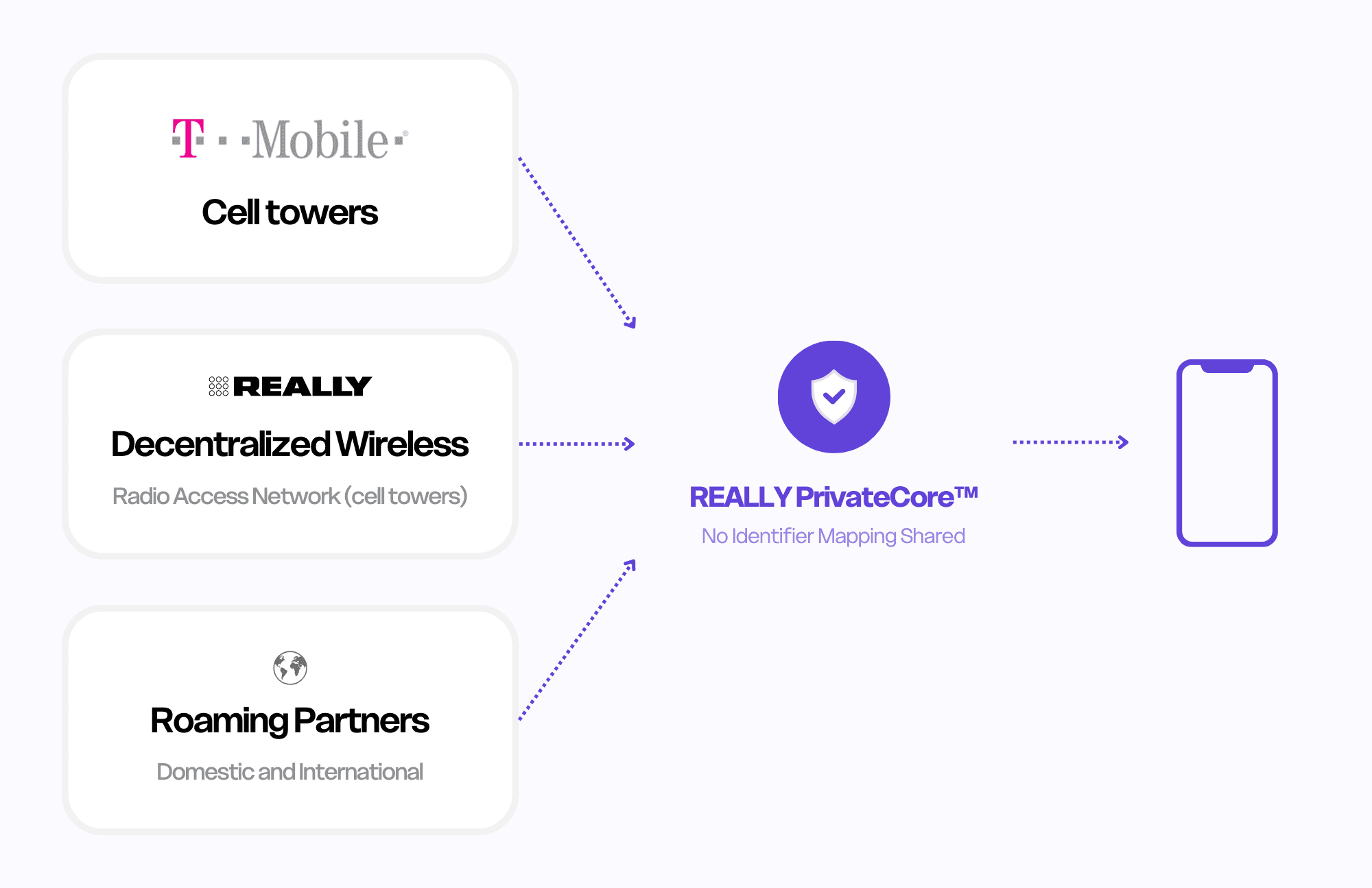
- REALLY’s has a built-in software layer we call our PrivateCore™ (think of it as a VPN for telecom) that prevents T-Mobile or any roaming partners from tracking or storing personal information and data. REALLY is governed by a Zero Trust Protocol (ZTP), so we don’t store unnecessary data, and can’t sell what we don’t have.
- REALLY’s PrivateCore™ protects user’s privacy while still allowing the service to leverage global telecom networks to get amazing coverage and fast speeds, especially combined with REALLY’s DeWi network.
- On top of that, we offer encrypted calling and a built-in VPN to protect your communications.
The Critic’s Question
“Is REALLY just fear-mongering? How exactly do big carriers ‘expose’ me?”
Why It Matters
Privacy risk doesn’t come from just one thing; it’s a combination of:
Storage: Keeping massive amounts of PII (personally identifiable information) and your activity logs for months or years, creating honeypots for hackers and making it easier for governments or insiders to misuse it.
Monetization: Selling, sharing, or brokering that stored data with advertisers, analytics firms, and third parties.
Big Wireless does both.
Even if your personal data is never sold, the fact that it’s stored in the carrier’s sprawling and often incsecure systems increases your exposure. And once it is monetized, you’re turned into a product without your explicit consent.
How Big Wireless Works
Here’s what happens in a typical legacy carrier:
Metadata exhaust: Every call, text, and session generates Call Detail Records (CDRs), tower pings, IP logs, and device identifiers.
Roaming/wholesale partners: If you’re an MVNO (like Mint or Consumer Cellular), they either use a third party system or their carrier’s system, and then everyone can see all the logs and all your subscribers’ data.
Storage: Carriers keep those records far longer than necessary, often for years.
Monetization: The stored data is packaged, shared, or sold—sometimes openly, sometimes quietly, until regulators step in.
This is why the FCC has fined major carriers hundreds of millions of dollars for selling or mishandling customer location data.
The REALLY Difference
We designed our architecture to break this cycle, including a “data layer” and “communications layer”:
No unnecessary data collection and storage: If it’s not required to deliver your service, we don’t keep it.
No monetization: Your data is not an ad product, period.
Our own PrivateCore™: Unlike most MVNOs, we don’t use T-Mobile’s (or anyone else’s) software systems or ERP. That means roaming partners never see the full subscriber data set, just what’s technically required for tower access.
Segmented + controlled: Where retention is unavoidable (e.g., billing), it’s tightly encrypted in transit and at rest, siloed, access-controlled, and never resold.
The result: REALLY gives you coverage without siphoning off your personal data, and we don’t store or sell it ourselves.
More Than Data Minimization
Privacy at REALLY goes beyond limiting collection. We also build communication protections into the service itself:
Encrypted calling: We use stronger defaults and SIM swap protections to keep your voice calls more private. While no system is perfect (see our explainer on “Encrypted Calling”), we raise the baseline significantly.
Included VPN: Our telco-native VPN protects your data in transit so nobody can see your web browsing or app usage. (See our VPN explainer for details.)
Additional privacy and security tools provided by REALLY + Aura
Together, these give you privacy at the data layer (what we don’t store or sell) and the communications layer (what others can’t see in transit).
What This Means for You
With REALLY:
Your carrier doesn’t stockpile your information.
Your carrier doesn’t monetize your data.
Your calls and browsing sessions are protected by default.
Your phone still works on the same towers, but the host carrier doesn’t get to keep a mirror of your life.
Wrap-Up
Big Wireless exposes you in two ways:
They store your data for years.
They monetize it through resale.
REALLY does neither. Instead, we:
Prevent roaming partners from siphoning your data.
Avoid unnecessary retention.
Protect your calls and traffic with encryption and VPN.
Switching isn’t just about coverage or price. It’s about choosing a carrier that works for you, not one that sells you out.
Sources: FCC CPNI rules & certification guidance; major FCC enforcement actions on location data; NIST SP 800-53 (AU/AC families) mapping to controls.
Proof & verification (in progress)
Policy: Public Retention Matrix (e.g., tower-level CDRs ≤ X days); No-Monetization Attestation (signed by CTO/GC).
Architecture: “Big Wireless vs. REALLY” data-flow diagram (field-level notes on what’s created/stored/shared).
Audit: SOC 2 Type II & ISO/IEC 27701 summaries—control IDs covering logging, retention, and vendor access.
Tests: Quarterly retention drill (“request after TTL” → no data found); sample masked/rotated logs.
Transparency: Law-enforcement transparency report; security/privacy change log (e.g., “CDR TTL reduced from 30→14 days”).
Contracts: Roaming interface field whitelist (explicit PII exclusions) + retention ceilings; DPAs forbidding secondary use/re-ID.
Join the only carrier that makes privacy non-negotiable.