
Summary
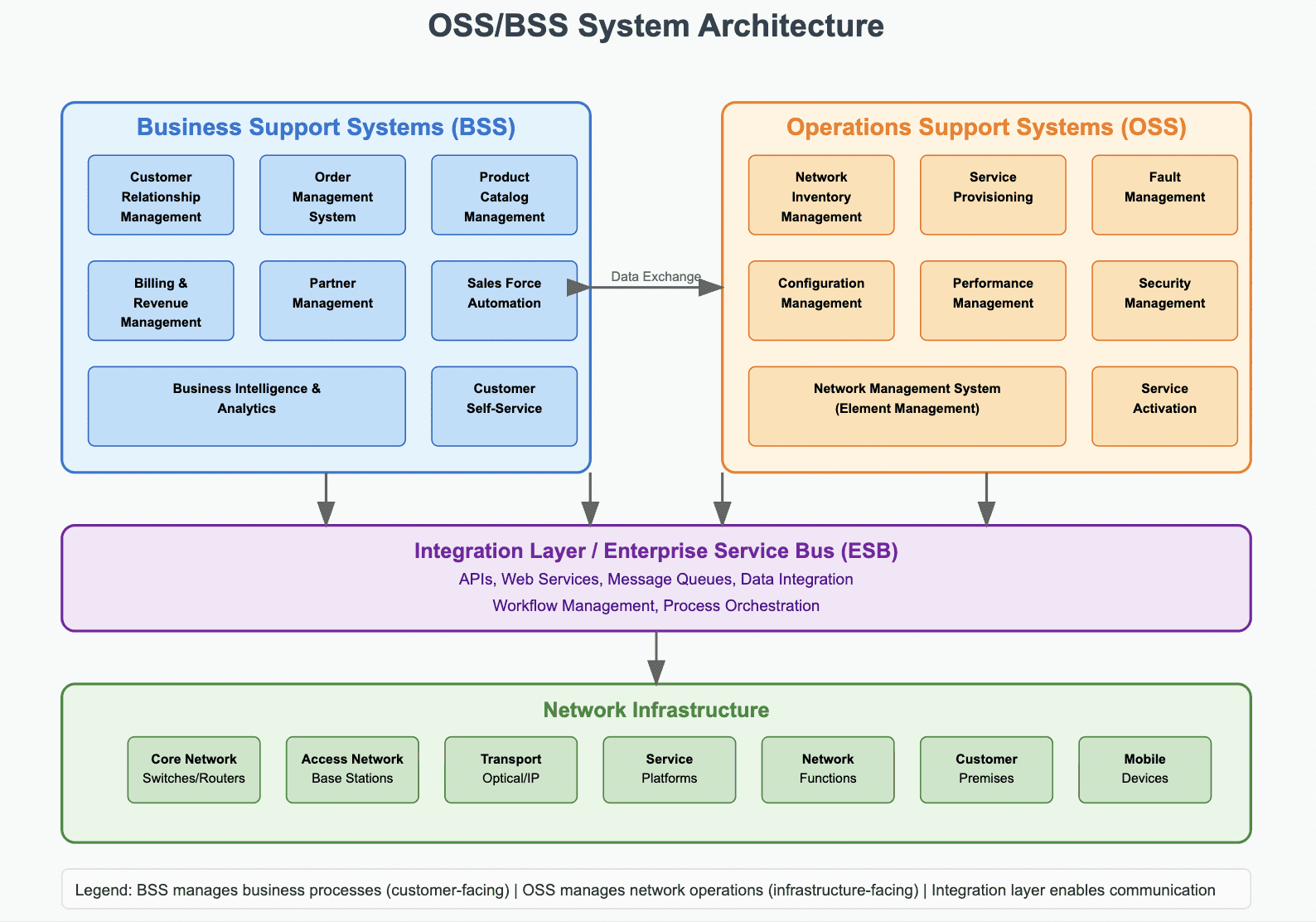
The OSS/BSS system is a key piece of the mobile technology stack or software layer that makes up REALLY's PrivateCore™. The OSS/BSS is the carrier’s “brain.” It creates and activates lines, assigns/ports numbers, turns features on/off, defines plan entitlements/configurations, provisions SIM/eSIM, and coordinates billing and support.
BSS (Business Support Systems) = plans, activation, number management/porting, charging/billing/payments, and customer support.
OSS (Operations Support Systems) = provisioning SIM/eSIM, service on/off, inventory/configuration, monitoring, and troubleshooting.
REALLY’s OSS/BSS runs on anonymous signup & systems, keeps operational records minimal and short-lived, and doesn’t build a centralized, identity-linked archive or monetize customer data.
The Critic’s Question
“What exactly is OSS/BSS—and how could it impact my privacy? Why should I care?”
Answer (short): OSS/BSS is the software that sets up and runs your service, and at most carriers it’s also where the identity-linked data that gets hacked lives (PII, billing details, usage metadata like CDRs/XDRs, support notes) in a centralized archive. REALLY doesn’t build that archive: we use anonymous signup & systems, keep records minimal and short-lived, maintain no subscriber-identity mapping, run with field-whitelisted interfaces, and don’t monetize data, on servers operated by REALLY. Net effect: even if someone breached us, there’s no one-stop identity-linked dossier to steal.
Plain-English: What OSS/BSS Does
BSS (Business)
Plans & activation: create/modify lines, add features, handle number ports.
Charging & billing: rates, entitlements, invoices, payments, credits, refunds.
Customer care: support tools, ticketing, service changes, account adjustments.
OSS (Operations)
Provisioning: push SIM/eSIM and service configs; turn features on/off.
Inventory & configuration: track services/numbers and their settings.
Assurance & troubleshooting: monitor quality/alarms, open/resolve issues, produce health metrics.
Why It Matters
Reliability: Smooth activations, accurate features, and effective fixes depend on OSS/BSS.
Privacy: This is where many carriers keep long-lived, identity-linked records (and where leaks or mass surveillance happen). REALLY’s design avoids that outcome.
Where data lives—and what typically leaks
Legacy OSS/BSS stores: identity/account details (PII, payment info), numbers/SIM info, usage metadata (CDRs/XDRs), support notes, joins to analytics/marketing tools—often as a centralized, identity-linked archive.
Why leaks happen: one big target + many vendor/tool connections + long retention + over-permissioned access.
What leaks: PII, identity↔usage joins (who/when/where), support histories, and credentials/tokens.
REALLY’s difference: no PII, no subscriber-identity mapping, no centralized identity-linked archive, short, purpose-bound retention, field-whitelisted interfaces, no data monetization, and critical control on servers operated by REALLY. Even in a hypothetical breach, there’s no identity-linked dossier to exfiltrate—what exists is minimal, pseudonymous, and short-lived. The OSS/BSS in part of REALLY's PrivateCore™.
How REALLY’s OSS/BSS is Different
Anonymous signup & systems: REALLY operates on pseudonymous operational identifiers, not personal identity data.
No centralized, identity-linked archive: operational records exist only as needed, with short retention ceilings.
Minimal interfaces: strict field whitelists; no broad export pipelines; no data monetization.
Same great service: activations, billing, and support still work, just without the dossier.
Honest limits
Some operational and legal records are required to run a phone service (e.g., provisioning status, billing events). The key is scope and time: collect the minimum and keep it briefly.
Partners providing radio access hold their own RF/operations logs; REALLY doesn’t supply personal identity or a centralized, identity-linked archive to join those.
Join the only carrier that makes privacy non-negotiable.