


How AI Is Transforming Mobile App Experiences in 2026
As consumer demands become more complex, the need for intelligent solutions has led organizations to increasingly adopt innovative technologies to improve mobile app development worldwide.
In today’s high-tech world, Artificial Intelligence (AI) is no longer a futuristic concept. It is a stark reality, especially in mobile applications. AI plays a major role in changing how users use these applications by enabling more personalized, intuitive experiences.
From assisting consumers through virtual assistants to offering predictions or advanced security features, there are many ways through which AI can help businesses create valuable mobile apps and improve user engagement and retention.
Whether it comes to mobile apps for healthcare, retail, finance, education, logistics, or entertainment, AI-powered mobile applications have proved successful across industries. Here is an insight into how AI is changing mobile app experiences in 2026.
Improved App Performance and Efficiency
First and foremost, AI technology is helping improve not just features, but also the performance of mobile applications. It facilitates battery usage optimization, resource management, bug detection, and performance tracking. As a result, the apps run more smoothly on various devices and platforms. Thus, users get faster and more efficient applications with better performance.
Enhancing Personalized User Experiences
Among the main benefits of AI-based mobile app development in UAE and globally is personalization. The previous version of mobile applications had the same interface for all users, regardless of how they used it. AI-based applications can learn from the behavior, preferences, and interactions to personalize their content and recommendations.
Some examples include:
- Personalized products in e-commerce applications
- Customized music playlists in streaming services
- Personalized news feed and recommendations
- Adaptive fitness and wellness programs
- Learning courses according to the personal learning path in educational applications
The more a user uses an application, the more personalized its recommendations become. In turn, this contributes to higher customer satisfaction, higher engagement rates, and higher conversion rates.
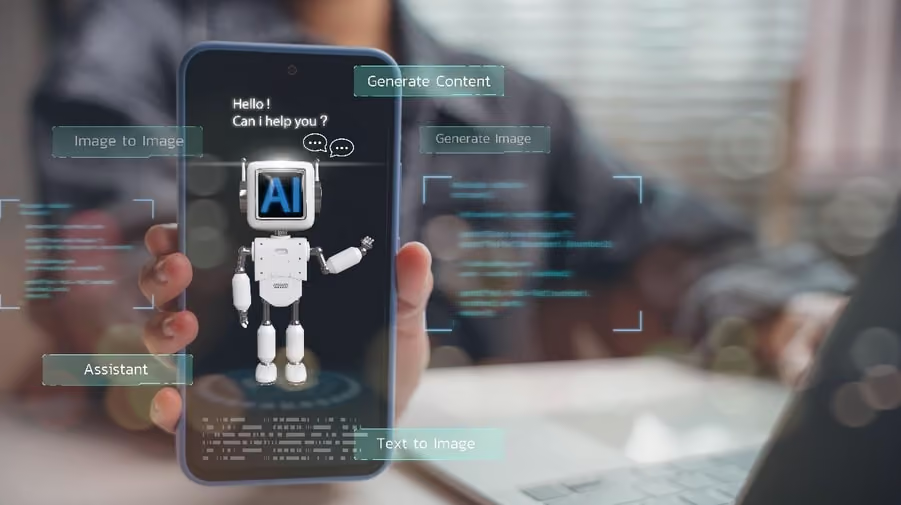
Smarter Virtual Assistants and Chatbots
AI-based virtual assistants have evolved significantly in 2026. Current mobile apps offer advanced AI technology that can understand natural language, context, and intentions of the user. Firms save on costs while customers experience speedy interactions 24/7.
Unlike earlier AI chatbots that relied on programmed responses to user queries, modern AI assistants can handle complex queries and manage customer service issues more efficiently. They can also make appointments, recommend products, and complete purchases.
Predictive Analytics Enhancing User Engagement
AI enables mobile apps to anticipate user actions before they happen. Using predictive analytics, apps can analyze historical data to identify trends that help predict future actions.
For instance, with the help of AI, shopping apps can predict the purchases that a customer is going to make by analyzing their previous browsing or purchasing habits. In the same way, streaming services can recommend movies or TV shows even before users start searching for them.
Such functions allow apps to:
- Increase engagement
- Improve customer retention
- Reduce user friction
- Deliver timely recommendations
- Enhance overall satisfaction
Advanced Voice Recognition Technology
Voice-based interactions have become even more popular as users seek more efficient ways to communicate through technology. AI has made substantial improvements in speech recognition, enabling more accurate voice commands in mobile apps. In 2026, voice-enabled technology will be widely used not only for content searches and sending messages but also for smart device control, app navigation, and accessibility support.
Voice recognition technology is especially useful for people looking for hands-free solutions and/or accessibility features. As AI language model development advances, conversations are becoming increasingly natural through voice technology.
Enhanced Mobile Security
Cybersecurity is still at the forefront of both business and customer concerns. The importance of AI in securing mobile applications is evident in how it detects and responds to suspicious activity in real time. The use of these technologies ensures not only better protection but also convenience.
Advanced AI security systems have the ability to:
- Detect suspicious login attempts
- Monitor behavioral patterns
- Detect fraudulent activities
- Protect against account takeover
- Detect malware threats
In addition, biometric identification techniques based on artificial intelligence, such as facial recognition and voice authentication, are becoming increasingly sophisticated and efficient.
Real-Time Language Translation
With greater global connectivity, the need for multilingual communication has become greater. AI-driven translation services are revolutionizing mobile apps as they allow for instant cross-language communication. Instant text and voice translation, multilingual customer support, and cross-border communication capabilities are among the key AI features offered by many apps.
Such features are particularly important for international businesses, as they can help them expand their customer base regardless of language barriers and contribute to greater inclusivity in mobile applications.
AI-Powered Healthcare Applications
Today’s health and wellness mobile apps use AI to provide users with insightful, personalized suggestions based on their health information.
Some ways that AI technology is making our lives easier using healthcare apps:
- Assessing symptoms
- Helping with medication
- Taking care of your mental health
- Tracking your fitness activities
- Sleep tracking
- Chronic conditions treatment
In fact, some sophisticated health apps are even helping doctors make sense of patients’ health information. With this proactive insight into users' health, AI allows users to make smarter decisions.
Intelligent Shopping Experiences
E-commerce applications are evolving to become more intelligent due to AI-powered features. Today’s online shopping applications provide more personalized shopping experiences than in-store shopping. Popular AI-driven features in e-commerce include product recommendations, price optimization, promotions tailored to personal data, and even virtual shopping assistants.
In addition to these, some e-commerce applications employ computer vision technology that enables users to search for products using images rather than text.
Context-Aware Applications
Context-aware computing has emerged as an important trend in the domain of mobile applications. Using AI, applications can identify a user’s surroundings, location, behavior, and preferences in order to deliver a better experience.
For instance, navigation applications can provide route alternatives based on the traffic conditions. E-commerce applications can offer location-based discounts, and productivity applications can adjust notifications based on the user’s activity.
Conclusion
Artificial Intelligence has completely changed the way mobile apps function in 2026. It helps users with personalized recommendations, predictive analysis, enhanced security systems, intelligent virtual assistants, and much more.
With growing consumer demand for digitization and personalization, businesses need to adopt AI-powered solutions to remain competitive and relevant. Firms investing in intelligent mobile apps at present are laying the groundwork for increased customer loyalty and success.
compare phone plans and save up to 80%


.svg)
.svg)

compare your carrier and save up to 63%


.svg)

.svg)

