


T-Mobile has spent the last few years winning every 5G speed test in sight. But speed tests happen outside, and you live inside.
That distinction matters more than most people realize. A carrier can dominate a coverage map and still drop to one bar the moment you walk into your apartment, office, or any building with thick walls. And unlike outdoor signal, indoor performance is something you can't verify from a map before you sign up.
The short answer: T-Mobile's indoor coverage is genuinely strong in most urban and suburban areas, largely thanks to its mid-band 5G network. But there are real gaps, and where those gaps show up depends less on your ZIP code and more on your specific building and location.
Here's what T-Mobile's indoor signal actually looks like in the real world, and what to check before you commit to a plan.
Why Indoor Coverage Is a Different Problem Than Outdoor Coverage
Your carrier's coverage map and your actual indoor signal are two separate things, and confusing the two is how most people end up disappointed after switching.
Cell signals travel as radio waves, and every barrier they pass through costs them strength. Concrete, metal framing, and reinforced flooring each chip away at the signal before it reaches you. By the time it gets to a back room, basement, or interior office, it can be a fraction of what the tower is actually broadcasting.
The frequency band a carrier uses determines how much strength survives that journey. Lower frequencies travel farther and push through obstacles more easily. Higher frequencies carry faster speeds but lose power quickly against solid materials. That trade-off is the single biggest factor in how any carrier performs inside a building.
Coverage maps do not capture any of this. They show predicted outdoor signal at street level, not what happens once that signal has to push through your specific walls and windows. That gap between what the map shows and what you feel indoors is real, and it applies to every carrier.
Knowing this changes how you evaluate indoor performance, because the right question is never just how strong the signal is outside but how much of it actually makes it through.
Does T-Mobile Have Good Indoor Coverage? The Honest Answer
T-Mobile's indoor coverage is genuinely strong in many parts of the country, but it is not consistent everywhere, and the gap between its best and worst markets is wider than most carriers will admit.
For most people in urban and suburban areas, T-Mobile's indoor performance is among the best available right now. Its mid-band 5G network, built largely on 2.5GHz spectrum acquired through the Sprint merger, sits in a frequency sweet spot that balances speed and wall penetration better than the high-band mmWave 5G that other carriers initially prioritized. In covered markets, this translates to noticeably stronger and more reliable signal inside typical homes, apartments, and office buildings.
Where it gets more complicated:
- In rural markets, T-Mobile still relies heavily on low-band 600MHz spectrum. This frequency travels farther but delivers slower speeds, and indoor performance in these areas can feel inconsistent depending on how far you are from the nearest tower.
- Large commercial buildings with thick concrete walls, reinforced flooring, and minimal windows present a challenge for any carrier, T-Mobile included.
- Underground spaces like basements and parking garages remain difficult environments regardless of which network you are on.
According to Opensignal's 2024 U.S. Mobile Network Experience report, T-Mobile ranked first in indoor download speeds in major metro markets, outperforming both Verizon and AT&T in dense urban environments.
RootMetrics' most recent biannual report shows a more nuanced picture, with T-Mobile leading on speed but Verizon holding an edge in overall indoor reliability in certain suburban and rural markets.
The honest answer is that T-Mobile's indoor coverage is excellent in the right markets and genuinely average in others. Where you live and work matters more than the carrier's national reputation.
Why T-Mobile Actually Has a Structural Indoor Advantage Over Most Carriers
T-Mobile's indoor performance is not just marketing. There is a specific technical reason it outperforms most carriers indoors in covered markets, and it traces back to one decision made during the Sprint merger.
When T-Mobile acquired Sprint in 2020, it inherited a substantial block of 2.5GHz mid-band spectrum. Most carriers at the time were either sitting on low-band spectrum (wide coverage, slower speeds) or chasing high-band mmWave 5G (very fast, almost no wall penetration). T-Mobile landed in the middle, and that middle is exactly where indoor coverage lives.
Why Mid-Band Wins Indoors
2.5GHz mid-band penetrates walls, concrete, and glass better than mmWave while delivering significantly faster speeds than low-band LTE. For everyday indoor environments, this combination is as close to ideal as current wireless technology gets. No other major U.S. carrier has matched T-Mobile's mid-band footprint at the same scale.
How T-Mobile's Spectrum Stacks Up
Verizon built its 5G identity around mmWave, which is fast outdoors but barely clears a window. Its C-Band rollout has helped, but its mid-band footprint remains smaller than T-Mobile's. AT&T carries a more balanced spectrum mix but has not deployed mid-band at the same density in most major markets.
T-Mobile's indoor advantage is real, measurable, and built on a spectrum position that took years and billions of dollars to establish, which is why competitors cannot close that gap quickly. For a closer look at how other carriers compare on network performance, our Verizon vs. US Cellular breakdown is worth reading before you make a final decision.
Where T-Mobile's Indoor Coverage Still Falls Short
T-Mobile's indoor advantage is real in the right markets, but there are specific situations where it underdelivers, and knowing them upfront saves you from an unpleasant surprise after signing up.
Rural Areas
Outside major cities and suburbs, T-Mobile's mid-band 5G footprint thins out considerably. In rural markets, the network falls back on 600MHz low-band spectrum, which covers more ground but delivers slower speeds and less consistent indoor performance. If you live or work in a less populated area, the indoor experience on T-Mobile can feel noticeably different from what urban users experience.
Large Commercial Buildings
Even mid-band signal has its limits. Warehouses, large office complexes, hospitals, and industrial buildings with thick concrete walls, reinforced steel, and minimal windows can absorb enough signal to create weak spots throughout the interior. The larger the building's footprint, the harder it is for any tower-based signal to reach the center of the space reliably.
Basements and Underground Spaces
Below-ground environments are where every carrier struggles, T-Mobile included. Parking garages, basement apartments, and underground offices sit beneath enough material to block most signal regardless of how strong the outdoor coverage is above ground.
Markets Where Mid-Band Rollout Is Still Incomplete
As of 2026, T-Mobile's mid-band deployment, while extensive, is not universal. Some suburban and secondary markets are still transitioning from low-band coverage, meaning the indoor experience in those areas has not yet caught up to what T-Mobile delivers in its most developed markets.
T-Mobile's indoor gaps are specific and identifiable, which means they are also avoidable with the right information before you commit.
T-Mobile vs. Verizon vs. AT&T: Who Actually Wins Indoors?
All three carriers claim strong nationwide coverage, but indoor performance tells a more specific story, and the differences between them are measurable.
T-Mobile
T-Mobile's mid-band 5G network gives it the strongest indoor speed performance in urban and suburban markets. Opensignal's 2024 U.S. Mobile Network Experience report ranked T-Mobile first in indoor download speeds across major metro areas. Its advantage is most pronounced in dense cities and modern office buildings where mid-band signal can reach effectively.
Verizon
Verizon's strength is reliability rather than speed. Its low-band LTE network is mature and consistent, performing well in suburban homes and smaller cities. In dense urban high-rises, Verizon's indoor performance is more inconsistent, and while its C-Band 5G rollout has narrowed the gap with T-Mobile, its mid-band footprint is still smaller in most markets. RootMetrics consistently ranks Verizon at or near the top for overall network reliability, including indoors, but trails T-Mobile on indoor 5G speeds specifically.
AT&T
AT&T runs a balanced mix of low-band and mid-band spectrum, delivering reliable indoor performance in suburban areas. Its FirstNet infrastructure gives it a specific edge in public buildings like hospitals and government facilities. In dense urban environments, AT&T generally falls between T-Mobile and Verizon for indoor performance.
Here is how all three compare across common indoor environments:
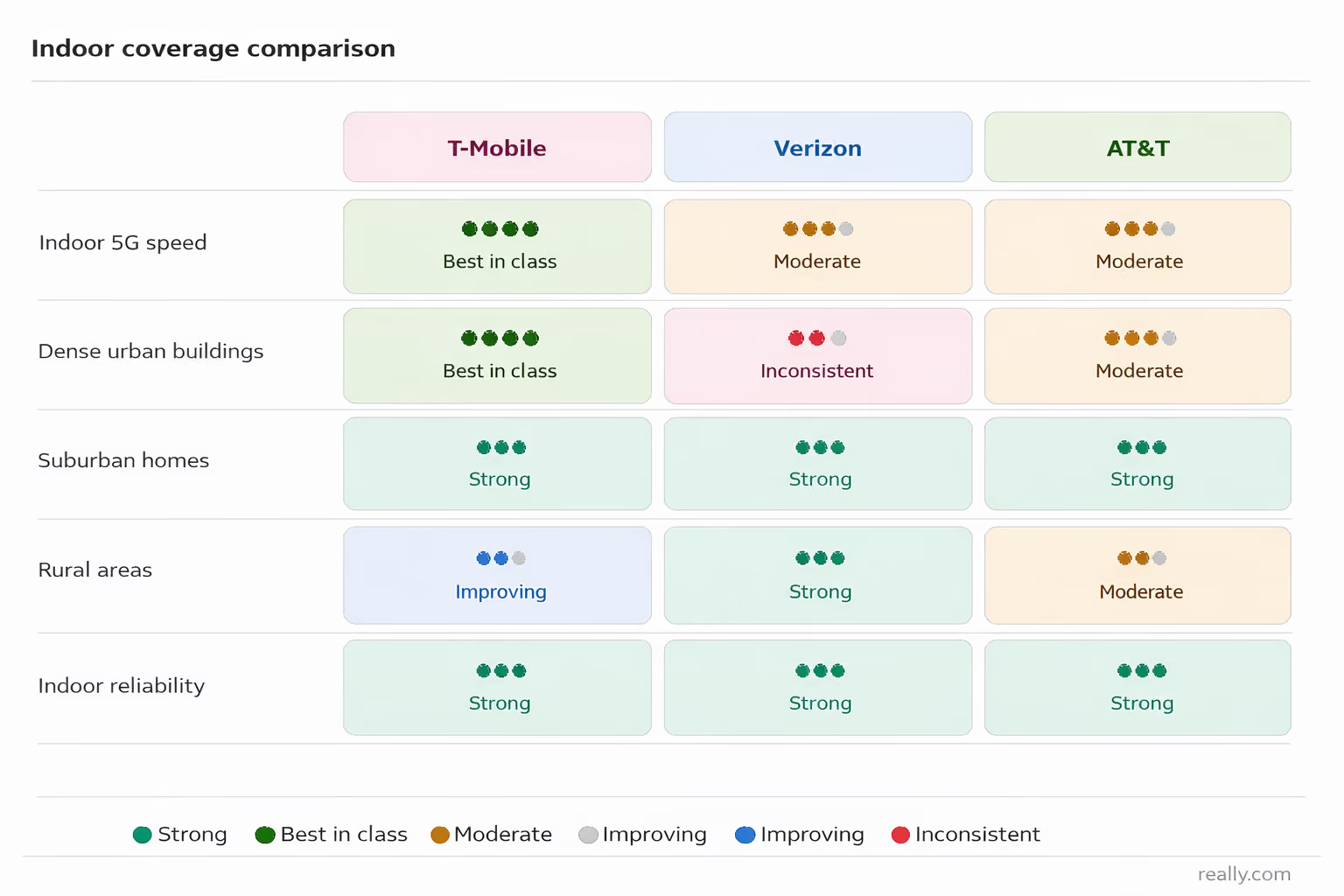
The bottom line: T-Mobile leads on indoor speed in cities, Verizon leads on suburban and rural reliability, and AT&T sits reliably in the middle. Which one wins for you depends entirely on where you spend most of your time indoors.
How Your Building Type Affects T-Mobile's Indoor Signal
T-Mobile's network can perform very differently depending on the structure you are inside, and your building type often matters more than how many bars you see outside.
Older Homes and Single-Story Buildings
These tend to be the most forgiving environments for indoor signal. Wood framing, standard drywall, and older single-pane windows put up relatively little resistance to radio waves. In these structures, T-Mobile's mid-band signal generally holds up well and reflects outdoor coverage closely.
Modern Construction
Newer buildings are often the biggest surprise. Low-E glass windows, now standard in most new construction, are coated with a metallic layer that reflects heat and radio waves equally well. Combined with steel framing, reinforced concrete floors, and dense insulation, a brand new apartment building can have noticeably worse indoor reception than one built decades earlier a block away.
High-Rise Apartments and Office Buildings
Upper floors benefit from clearer line-of-sight to nearby towers. Middle floors, surrounded by other buildings and shielded by the structure's concrete core, are typically the most problematic. Elevator shafts, thick internal walls, and the sheer density of materials between you and the nearest tower all compound the signal loss.
Basements and Underground Spaces
Every carrier struggles below ground, and T-Mobile is no exception. Basement apartments, underground parking garages, and below-grade offices sit beneath enough material to block most signal regardless of how strong coverage is at street level above them.
Large Retail and Commercial Spaces
The challenge in big-box stores, warehouses, and large commercial buildings is not wall thickness but footprint. A signal strong enough to enter the building may not carry reliably to the center of a 100,000 square foot space without dedicated in-building infrastructure in place.
Your building type is one of the most reliable predictors of your indoor experience, and understanding which category you fall into gives you a realistic picture of what to expect from any carrier's network where you actually spend your time. If you are still weighing your carrier options, our Spectrum Mobile review is a solid next read before you commit.
How to Fix Poor T-Mobile Indoor Signal Without Switching Carriers
A weak indoor signal on T-Mobile is frustrating, but in most cases it is fixable without changing your plan or your carrier.
Turn On Wi-Fi Calling First
This is the fastest fix and it costs nothing. Wi-Fi calling routes your calls and texts through your home internet connection instead of the cell network. As long as your Wi-Fi is stable, call quality indoors becomes reliable regardless of how weak your cell signal is.
To enable it, go to Settings on your iPhone or Android device, search for Wi-Fi Calling, and toggle it on. T-Mobile supports Wi-Fi calling across all current smartphones on its network.
T-Mobile Signal Boosters
T-Mobile does not sell its own branded network extender the way some carriers do, but it does support a range of FCC-approved third-party signal boosters that are fully compatible with its network.
Brands like weBoost and SureCall make boosters certified for T-Mobile's frequency bands, including its mid-band 5G spectrum. These devices amplify existing outdoor signal and rebroadcast it inside your home or office. A few things worth knowing before buying one:
- They require some outdoor signal to work. If T-Mobile has no signal at your location outside, a booster will not help.
- Entry-level models start around $200 to $300 and cover smaller spaces. Whole-home models run $500 and up.
- Installation involves mounting an external antenna on a roof or exterior wall, straightforward for most houses but less practical in apartments.
Check Your Wi-Fi Router Placement
If you are relying on Wi-Fi calling, your router's position matters more than most people realize. A router tucked in a closet or on a different floor from where you make most calls can introduce lag and dropped calls even when your internet speed is technically fine. Moving it to a central location on the same floor makes a noticeable difference.
Contact T-Mobile Before Assuming It Is Your Building
If your signal has recently gotten worse in a location where it used to be fine, it is worth checking whether T-Mobile has a known outage or is performing tower maintenance in your area. T-Mobile's app and website both have outage checkers, and their support team can confirm whether a network issue rather than your building is the cause.
Most indoor signal problems have a practical solution, and finding the right one depends on identifying what is actually causing the issue in your specific space. If you want to go deeper on optimizing your phone's network settings, our guide on what Private DNS is and how to use it is a useful next read.
Is T-Mobile's Indoor Coverage Still Improving in 2026?
T-Mobile's indoor coverage has improved considerably over the past three years, and the changes happening now are structural, not cosmetic.
Mid-Band 5G Expansion Into Underserved Markets
T-Mobile's most impactful ongoing work is extending its 2.5GHz mid-band 5G into markets still relying on low-band coverage. As of 2026, mid-band has reached the majority of the U.S. population, but secondary cities, suburban fringes, and rural corridors are still being filled in. For indoor users in these transitioning markets, the difference when mid-band arrives is immediate and noticeable.
Distributed Antenna Systems in High-Traffic Venues
Where tower-based signal cannot penetrate large structures, T-Mobile has been expanding its Distributed Antenna System (DAS) installations. A DAS places multiple small antennas inside a building, delivering signal from within rather than relying on it to pass through walls. Active installations now span stadiums, airports, transit systems, university campuses, and large commercial buildings, with the footprint continuing to grow through 2026.
Where Things Stand Now
The indoor gap that defined T-Mobile's weakest markets in 2022 and 2023 has narrowed meaningfully. Mid-band expansion has addressed the speed and penetration limitations of low-band coverage, and DAS buildout has filled in the large venue blind spots that tower signal alone could not solve.
T-Mobile's indoor network is not finished, but it is substantially stronger than it was three years ago, and the remaining gaps are closing faster than most people realize.
Should You Choose T-Mobile for Indoor Coverage?
T-Mobile is a strong indoor coverage choice in the right market, but it is not the right answer for everyone.
It makes the most sense if you live or work in an urban or suburban area where its mid-band 5G is fully deployed. In those markets, it consistently leads on indoor speed and signal stability. If fast, reliable indoor 5G in a major city or well-covered suburb is your priority, T-Mobile is the strongest option available right now.
Where it makes less sense is in rural areas or markets where mid-band coverage is still incomplete. In those locations, the indoor experience is more comparable to what other carriers offer, and overall reliability may matter more than speed. In that case, Verizon is worth a closer look.
Before committing, test T-Mobile at your actual address. Its Test Drive program offers a 30-day free trial on your existing phone without switching your number. Use that window to check signal in the specific rooms and buildings where you use your phone most.
The right carrier is the one that works where you actually are, and no map substitutes for testing it yourself.
Frequently Asked Questions
Here are the most common questions about T-Mobile's indoor coverage, answered directly.
Who Owns T-Mobile's Network Infrastructure?
T-Mobile owns and operates its own network infrastructure across the U.S. It does not lease coverage from another carrier for domestic service, which means the signal strength and data speeds customers experience indoors are a direct reflection of T-Mobile's own towers and spectrum investments.
Can Network Congestion Affect T-Mobile's Indoor Signal?
Yes. During peak usage times, bandwidth is shared across more customers, which can reduce data speeds indoors even when signal strength looks fine. This is most noticeable in dense areas where large numbers of users are accessing the same cell coverage simultaneously.
Does Your T-Mobile Plan Affect Indoor Coverage?
Not directly. Indoor signal strength depends on network infrastructure and spectrum availability at your location, not which plan you are on. All T-Mobile plans access the same network, so upgrading your plan will not improve poor indoor cell coverage at your address.
Can Your Phone Affect How Well T-Mobile Works Indoors?
Yes. Older cell phones that do not support T-Mobile's mid-band 5G frequency bands will connect to low-band spectrum instead, which means slower data speeds and less consistent indoor connectivity even in areas with strong mid-band availability. Upgrading to a device that supports T-Mobile's full spectrum range gives you access to the best indoor performance the network offers.
Does T-Mobile's Indoor Coverage Work Internationally?
T-Mobile offers international roaming across 215-plus countries, but indoor performance abroad depends entirely on the local carrier's network infrastructure rather than T-Mobile's own. Signal strength and faster data speeds indoors will vary significantly depending on the country and the partner network handling your connectivity.
compare phone plans and save up to 80%


.svg)
.svg)

compare your carrier and save up to 63%


.svg)

.svg)

