


Verizon has the largest network in the U.S. But large doesn't always mean strong, especially once you're inside a building.
If you've noticed your signal drop the moment you walk through a door, you're not imagining it. Outdoor coverage and indoor coverage are two very different things, and most carriers, Verizon included, are much better at one than the other.
The short answer: Verizon's indoor coverage is solid in most suburban and rural areas, but inconsistent in dense urban buildings, newer construction, and anywhere with thick concrete or low-E glass. Whether that's "good enough" depends entirely on where you spend most of your time.
Here's what's actually going on with Verizon's signal indoors and how to know if it's working for you before you lock into a plan.
Why Indoor Coverage Is Harder Than Outdoor Coverage
Your phone's signal doesn't care about your floor plan, but your walls do.
Cell signals travel as radio waves, and radio waves lose strength every time they pass through a physical barrier. A single exterior wall can cut your signal noticeably. Add drywall, insulation, concrete, or metal framing and each layer chips away a little more. By the time the signal reaches you in a back bedroom or basement, it can be a fraction of what your carrier's coverage map shows outside.
The frequency a carrier uses matters just as much as how many towers they have nearby. The basic rule: lower frequencies travel farther and push through walls better, while higher frequencies carry more data but struggle with obstacles. This trade-off plays out differently depending on which network technology your carrier leans on.
Coverage maps also have a built-in limitation most people don't know about. They show signal strength measured at street level, outside. They are not designed to predict what happens once you step inside a building. That gap between what the map promises and what you actually experience indoors is real, and it is not unique to any one carrier.
Knowing this upfront changes how you evaluate any carrier's indoor performance, not just Verizon's.
Does Verizon Have Good Indoor Coverage? The Honest Answer
Verizon's indoor coverage is genuinely good in many places, but it has real blind spots that are worth knowing before you commit.
For most people in suburban areas and smaller cities, Verizon's low-band LTE and sub-6GHz 5G hold up well indoors. These frequencies are built for range and wall penetration, not raw speed, and that trade-off works in your favor when you're inside a typical home or single-story building.
Where it gets inconsistent:
- Dense urban environments, particularly in older high-rise buildings with thick concrete walls and steel framing, tend to give Verizon users more trouble.
- Newer commercial buildings with low-E glass windows, which are designed to reflect heat, also reflect radio waves and can noticeably weaken signal indoors.
- Basements and underground parking structures are where most carriers, Verizon included, struggle regardless of overall network strength.
According to RootMetrics' most recent U.S. reliability reports, Verizon consistently ranks at or near the top for overall network performance, but its indoor data performance shows more variability in dense metro areas compared to suburban and rural markets.
Opensignal's research echoes this. Verizon scores well on availability and reliability but trails T-Mobile in indoor download speeds in major cities, largely due to differences in spectrum strategy.
So is Verizon's indoor coverage good? For most of the country, yes. For people who live or work in dense urban buildings, the answer is more nuanced, and your specific building matters more than your ZIP code.
Verizon's Indoor Coverage vs. AT&T and T-Mobile: The Real Difference
All three major carriers claim strong nationwide coverage, but how they perform indoors tells a different story.
The gap comes down to spectrum strategy. Each carrier has built its network around different radio frequencies, and those choices have a direct impact on how well their signal behaves inside buildings.
T-Mobile
T-Mobile has the most aggressive mid-band 5G deployment in the U.S., built largely on its 2.5GHz spectrum from the Sprint merger. Mid-band sits in the sweet spot: strong enough to push through walls while still delivering fast speeds. In dense urban areas and office buildings, T-Mobile's indoor performance currently leads the pack. Opensignal's 2024 U.S. Mobile Network Experience report ranked T-Mobile first in indoor download speeds in major metro markets.
AT&T
AT&T runs a more balanced mix of low-band and mid-band spectrum. Its indoor performance is generally reliable, particularly in suburban areas, and its FirstNet network gives it an edge in public buildings like hospitals and government facilities where it has dedicated infrastructure agreements.
Verizon
Verizon built its reputation on low-band LTE, which travels well and holds up indoors in most typical buildings. The challenge is its 5G rollout. Verizon's C-Band mid-band 5G is expanding, but its footprint is still smaller than T-Mobile's, which means more Verizon customers are still relying on LTE indoors rather than 5G in many markets.
Here is how the three carriers stack up for indoor use specifically:
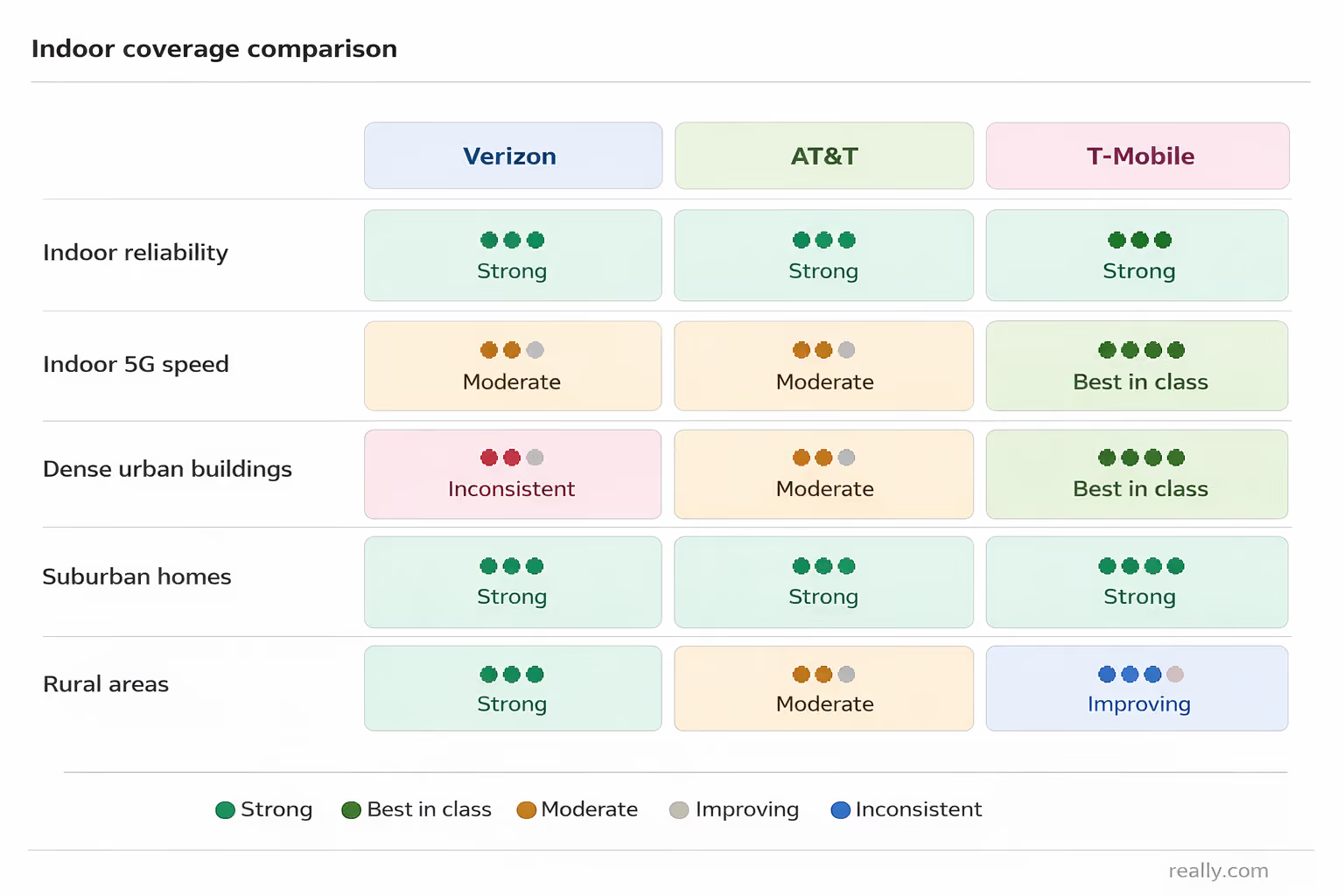
The bottom line: for most homes and suburban offices, all three carriers perform comparably indoors. Where the gap becomes noticeable is in dense urban buildings, where T-Mobile's mid-band advantage is real and measurable. Verizon remains a strong choice for reliability, but if fast indoor 5G in a major city is a priority, the comparison is worth doing before you decide.
How Your Building Type Affects Verizon's Indoor Signal
Not all buildings are equal when it comes to cell signal, and the one you're in right now may be working against you.
Older Homes and Single-Story Buildings
These tend to be the best-case scenario for indoor coverage. Wood framing, standard drywall, and older single-pane windows offer relatively little resistance to radio waves. If you have Verizon and live in a house built before the 2000s, chances are your indoor signal reflects what the coverage map shows fairly closely.
Modern Construction
Newer buildings are often the worst offenders, and most people don't realize it. Low-E glass windows, which are now standard in most new construction, are coated with a metallic layer designed to reflect heat. That same coating reflects radio waves. Steel framing, reinforced concrete floors, and insulated wall systems compound the problem. A brand new apartment building can have significantly worse indoor reception than a 40-year-old one a block away.
High-Rise Apartments and Office Buildings
Height helps on the upper floors, where line-of-sight to a nearby tower is clearer. The middle floors of a dense high-rise, surrounded by other buildings, are often the most problematic. Thick concrete cores, elevator shafts, and the sheer density of materials between you and the nearest tower all add up.
Basements and Underground Spaces
This one applies to every carrier without exception. Signal penetration drops sharply below ground level. Parking garages, basement apartments, and underground offices are genuinely difficult environments for any wireless network unless the building has dedicated in-building infrastructure installed.
Large Retail and Commercial Spaces
Big-box stores, warehouses, and large commercial buildings present a different challenge. The issue here is not wall thickness but footprint. A signal strong enough to enter the building may not reach the center of a 100,000 square foot space. This is why large venues often install dedicated distributed antenna systems, though coverage quality varies by location.
Your building type can matter more than your carrier, and more than your ZIP code. Knowing which category you fall into gives you a much clearer picture of what to realistically expect from Verizon's network where you actually spend your time. And if you are also reconsidering your plan while you are at it, our guide to the best unlimited cell phone plans is a good place to start.
Verizon's Own Tools for Indoor Coverage: How Accurate Are They?
Verizon gives you tools to check coverage before you sign up, but knowing what those tools are actually measuring makes a significant difference in how you interpret them.
The Coverage Map
Verizon's online coverage map is the first place most people check, and it looks reassuring almost everywhere. The catch is that it shows predicted outdoor signal strength, modeled from tower locations and terrain data. It is not measuring what happens inside your home, office, or apartment building.
Verizon does include an indoor coverage layer on its map, but this is still a model-based estimate, not real-world measurement. It does not account for your specific building's construction materials, floor level, or layout. A building shown as having strong indoor coverage on the map may perform very differently in practice depending on factors the model simply cannot capture.
Third-Party Tools
For a more grounded picture, third-party platforms offer data based on actual user experience rather than carrier modeling.
- Opensignal crowdsources real signal measurements from users running the app on their devices. Its reports reflect what people actually experience indoors and outdoors across different locations and network conditions.
- RootMetrics conducts structured drive and walk tests across the U.S., including indoor testing in malls, airports, and commercial buildings. Its biannual reports are among the most cited in the industry for objective carrier comparisons.
- Ookla's Speedtest provides real-time speed data from user-submitted tests and publishes aggregate results by carrier and location, useful for comparing actual performance in a specific city or region.
The Most Reliable Test
No tool beats testing Verizon's network at your actual address. Verizon offers a 30-day return window on new device purchases, which gives you enough time to evaluate real-world signal in the places you use your phone most.
The map is a starting point, not a verdict. Pairing it with third-party data and a real-world trial gives you a much more complete and honest picture of what to expect. If you want to see how carrier coverage research applies to another major network, our US Cellular coverage guide walks through the same process in detail.
How to Fix Poor Verizon Indoor Signal (Without Switching Carriers)
A weak indoor signal is frustrating, but in most cases it is fixable without changing your plan or your carrier.
Turn On Wi-Fi Calling First
This is the most overlooked fix, and it costs nothing. Wi-Fi calling routes your calls and texts through your home internet connection instead of the cell network. As long as you have a decent Wi-Fi connection, call quality indoors becomes a non-issue regardless of how weak your cell signal is.
To enable it on most Android and iPhone devices, go to Settings, search for Wi-Fi Calling, and toggle it on. Verizon supports Wi-Fi calling on all current smartphones across its network.
Verizon Network Extender
If Wi-Fi calling does not fully solve the problem, Verizon's Network Extender is the next step. It is a small device that connects to your home internet router and creates a dedicated mini cell tower inside your home, broadcasting a genuine Verizon LTE signal to nearby devices.
It currently retails for around $249.99 directly from Verizon. It works best in homes with a strong broadband connection and supports up to 8 simultaneous users. The trade-off is that it requires a reliable internet connection to function, so it does not help in areas with poor broadband.
Third-Party Signal Boosters
Signal boosters are a different solution. Rather than creating a new signal, they amplify an existing outdoor signal and rebroadcast it indoors. Brands like weBoost and SureCall are FCC-certified and compatible with Verizon's network.
A few things to know before buying one:
- They only work if there is some outdoor signal to amplify. If Verizon has no signal at your location outside, a booster will not help.
- Entry-level boosters start around $200 to $300 and cover smaller spaces. Whole-home models designed for larger square footage run $500 and up.
- Installation typically involves mounting an external antenna on a roof or exterior wall, which is straightforward for most single-family homes but less practical in apartments.
Check Your Router Placement
This applies specifically to Wi-Fi calling performance. A router tucked in a closet or on a different floor from where you take most calls can create lag and dropped calls even when your internet speed is technically sufficient. Positioning your router centrally and on the same floor as your main calling area makes a measurable difference.
Most indoor signal issues have a practical solution, and the right fix depends on what is actually causing the problem in your specific space. If you are also weighing whether Verizon is the right carrier for you overall, our Verizon vs. US Cellular comparison breaks down how the two networks stack up where it matters most.
Is Verizon's Indoor Coverage Getting Better? What's Changing in 2026
Verizon's indoor coverage has improved significantly over the past two years, and customers in covered markets are starting to feel the difference.
C-Band 5G Is the Biggest Shift
C-Band operates in the 3.7GHz to 3.98GHz range, sitting in the mid-band sweet spot: strong enough to penetrate walls more effectively than mmWave 5G while still delivering fast speeds. Verizon committed over $45 billion in C-Band spectrum licenses and has been deploying across major U.S. markets since 2022. By 2026, C-Band has reached the majority of the U.S. population, and customers who experienced inconsistent indoor signal a few years ago are increasingly finding the same locations now hold a stronger, more stable connection.
Distributed Antenna Systems in High-Traffic Venues
For large venues where tower signal struggles to penetrate, Verizon has expanded its Distributed Antenna System (DAS) installations. A DAS places multiple small antennas throughout a building's interior, bringing the signal inside rather than relying on it to pass through walls. Active installations now span stadiums, airports, convention centers, university campuses, and large office parks across the U.S., with the footprint continuing to grow through 2026.
Where Things Stand in 2026
Verizon's indoor coverage is not perfect, and dense high-rise environments in major cities can still present challenges. But between C-Band expansion and broader DAS deployment, the network today is meaningfully stronger indoors than the one that earned much of its early criticism.
Should You Switch Carriers for Better Indoor Coverage?
Switching carriers is not always the answer, but sometimes it genuinely is.
If your frustration is occasional dips in specific spots rather than a consistent problem throughout your home or office, switching is unlikely to solve it. Every network has gaps.
Where it makes sense is when the problem is persistent across the spaces you use most and available fixes have not helped. In those cases, T-Mobile's mid-band 5G footprint in urban areas makes it the strongest alternative for indoor performance specifically.
Before deciding, test the network at your actual address. T-Mobile offers a 30-day free trial through its Test Drive program on your existing phone without switching your number. AT&T and Verizon both offer 30-day return windows on new device activations.
The right carrier is the one that works where you actually are, and the only way to know that is to test it firsthand.
Frequently Asked Questions
Here are the most common questions about Verizon's indoor coverage, answered directly.
Does Verizon Work Well on All Mobile Devices Indoors?
Generally yes, but older mobile devices that do not support Verizon's newer frequency bands will connect to slower network layers and experience weaker signal indoors. Checking your network settings to ensure your device is set to the latest available network type is a simple fix many users overlook.
Can Network Congestion Affect My Indoor Signal?
Yes. During peak times, many users in densely populated certain areas will notice their service degrade indoors. If your phone works fine all the time in open spaces but struggles indoors at specific hours, congestion is likely compounding your building penetration issues.
Does Verizon Have Good Coverage for Phone Calls Specifically?
Yes. Voice calls on Verizon's network are reliable coverage across suburban and rural markets. Wi-Fi calling further strengthens call quality indoors where good signal alone may not be sufficient for clear phone calls.
How Does Verizon Compare to Budget Carriers for Indoor Coverage?
Many budget carriers run on Verizon's own network, meaning their network coverage footprint is identical. The real difference is priority. During congestion, budget carrier customers are deprioritized behind Verizon's postpaid customers, which means good service for Verizon customers can translate to noticeably worse service for MVNO users on the same network at peak times.
The best way to evaluate any carrier is to test it where you actually live and work. No map or report substitutes for real-world performance at your specific address.
compare phone plans and save up to 80%


.svg)
.svg)

compare your carrier and save up to 63%


.svg)

.svg)

